

AI-Assisted Content Workflow: How to Publish Faster Without Losing Brand Voice or Compliance
Most businesses face the same tension when it comes to content. Publish slowly with full editorial control, or publish fast with AI and hope nothing breaks. Neither option works at scale. A well-structured AI content workflow eliminates that trade-off by placing AI where it accelerates production and humans where judgement, accuracy, and brand integrity matter most. At Xanda, we use a 7-stage system that does exactly this: faster publishing, tighter quality control, and no compromise on compliance or voice.
This article walks through the workflow we use to deliver AI-assisted content for clients across regulated, commercial, and public-sector environments.
Why Most AI Content Workflows Fail
The problem is rarely the AI itself. It is the workflow around it.
Businesses that struggle with AI-assisted content tend to make the same mistakes. They treat AI as a replacement for human writers rather than a production tool. They skip governance entirely, feeding prompts into a model and publishing whatever comes back. There is no brand voice documentation guiding the output. No editorial standards applied to the draft. No human accountability at any decision point.
The result is content that reads like it was written by no one in particular. Generic in tone. Inconsistent in style. Occasionally inaccurate. And in regulated industries, potentially non-compliant.
The fix is not to stop using AI. It is to build a workflow where AI handles the heavy lifting and humans own the decisions.
The 7-Stage AI Content Workflow
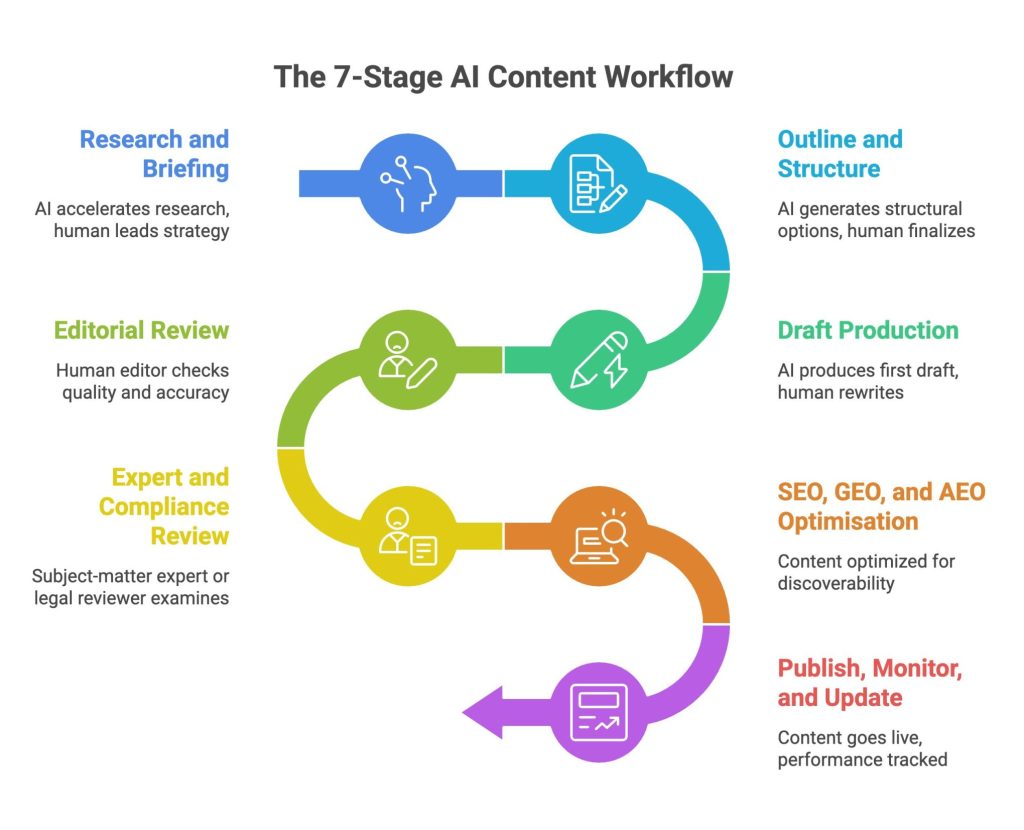
Every piece of content we produce at Xanda moves through seven stages. Each stage has a clear owner, a defined output, and a specific reason for existing. AI contributes at every stage, but never controls the outcome.
1. Research and Briefing
AI accelerates the research phase significantly. We use it for competitor content analysis, keyword clustering, search intent mapping, and identifying content gaps. This compresses hours of manual research into minutes.
However, the strategic brief is always human-led. We define the angle, the target audience, the primary and secondary keyphrases, and any compliance requirements that apply. If the content touches regulated territory (health claims, financial advice, legal guidance), those constraints are documented in the brief before a single word is written.
2. Outline and Structure
AI generates multiple structural options based on the brief: heading hierarchies, section flow, suggested subtopics, and FAQ candidates. This gives the editorial team a range of approaches to evaluate quickly.
Our writer then selects, reorders, and locks the final outline. The outline is approved against the brief before draft production begins. This prevents scope drift and ensures the structure serves the reader, the brand, and the search strategy.
3. Draft Production
AI produces the first draft. This is raw material, not the deliverable.
The draft gives the writer a foundation to work from: A structure populated with content that covers the right topics in roughly the right order. The writer then rewrites for brand voice, nuance, factual precision, and readability. Sentences are restructured. Claims are verified. Filler is removed. The tone is calibrated to match the client’s brand guidelines.
This stage is where the biggest time saving occurs. Starting from a populated draft rather than a blank page cuts production time considerably, without sacrificing the quality of the finished article.
4. Editorial Review
Before content moves any further, it passes through a human editorial review. This is the quality gate.
The editor checks brand voice consistency, factual accuracy, tone, readability, and structural coherence. They verify that the article delivers on the brief, that the keyphrase strategy is applied naturally, and that the content reads as if a knowledgeable person wrote it, because one did.
Any content that does not meet editorial standards is returned for revision. AI-generated phrasing that survived the rewrite is flagged and replaced.
5. Expert and Compliance Review
For content in regulated industries or sensitive subject areas, a subject-matter expert or legal reviewer examines the piece before publication. This applies to health and medical content, financial services, legal topics, and anything making claims that could expose the business to regulatory risk.
This stage is non-negotiable where compliance obligations exist. For general commercial content, it may be optional, but we always recommend it when the content involves specific product claims, data, or industry-regulated terminology.
AI cannot perform this review. It lacks the contextual judgement, legal awareness, and accountability required. Compliance is a human-only checkpoint.
6. SEO, GEO, and AEO Optimisation
Once the content is editorially and (where relevant) legally approved, it is optimised for discoverability across three environments: Traditional search (SEO), AI-driven search experiences (GEO), and direct-answer platforms (AEO).
This means checking and refining heading hierarchy, keyphrase placement, internal linking, schema markup, meta titles and descriptions, and FAQ formatting. Content is structured so that search engines and AI models can extract clear, accurate answers without misrepresenting the source material.
Optimisation happens after editorial approval, not before. This ensures the content is written for the reader first and structured for search second.
7. Publish, Monitor, and Update
Content goes live, but the workflow does not end at publication.
We track performance against defined KPIs: Organic visibility, ranking positions, engagement metrics, and conversion, where applicable. AI tools flag content decay, ranking drops, and emerging competitor content that may require a response.
Our team decides what to refresh, when to update, and whether a piece needs a minor revision or a full rewrite. The update cycle feeds back into Stage 1, keeping the content library current and competitive.
How This AI Content Workflow Protects Brand Voice at Scale
Brand voice breaks down when production scales without constraints. AI makes this problem worse if voice documentation is absent from the workflow.
In our system, brand voice is not something applied at the end. It is built into the process from the start. The brief references the client’s tone-of-voice guide. The outline is structured around messaging priorities the brand has defined. The writer rewrites against documented voice parameters. The editor reviews against the same standards.
AI operates within these constraints. It does not define the voice; it produces raw content that is then shaped by people who understand the brand. This is how you scale content production without diluting what makes a brand sound like itself.
At Xanda, every client engagement includes brand voice documentation as a foundational deliverable. Without it, no AI content workflow can protect consistency at volume.
Where Compliance Fits In (and Where It Cannot Be Automated)
AI can flag potential compliance risks. It can cross-reference claims against known guidelines. It can highlight language patterns that commonly attract regulatory scrutiny. These are useful capabilities, and we use them.
But AI cannot make a compliance decision. It cannot determine whether a health claim is substantiated under current ASA guidance. It cannot assess whether financial content meets FCA requirements. It cannot weigh the legal risk of a specific phrase in a specific regulatory context.
Compliance review requires human judgement, professional accountability, and contextual understanding that AI does not have. In our workflow, Stage 5 exists specifically because this responsibility cannot be delegated to a machine. Businesses operating in regulated sectors need this checkpoint to be human-led, documented, and auditable.
What This Means for Publishing Speed
The misconception about AI-assisted content is that it saves time on writing. It does, but that is not where the real efficiency gain lies.
The biggest improvement comes from compressing research, eliminating blank-page paralysis, reducing revision cycles, and removing workflow bottlenecks that slow teams down. When the brief is tighter, the outline is pre-validated, and the draft arrives already structured, the human editorial process moves faster because it starts from a stronger position.
In practice, a well-designed AI content workflow can reduce end-to-end content production time by 40 to 60 percent compared to a fully manual process, while maintaining or improving editorial quality. The bottleneck was never writing speed. It was workflow design.
Publishing faster does not mean publishing recklessly. An AI content workflow delivers speed because it removes inefficiency from the production process, not because it removes human judgement from the content. Every stage in the system exists for a reason: To ensure that what gets published is accurate, on-brand, compliant where required, and genuinely useful to the reader.
At Xanda, we build this workflow into every content engagement, whether through our AI-Enhanced Marketing & Websites service or our AI Creative Studio retainers. If your team is producing content at scale and needs a system that protects quality as output increases, get in touch.
FAQs
1. What is an AI content workflow?
An AI content workflow is a structured production process that uses artificial intelligence tools at defined stages (research, drafting, optimisation) while keeping human professionals responsible for strategy, editorial quality, brand voice, and compliance. It is designed to increase publishing speed without reducing quality or governance.
2. Can AI write content that matches my brand voice?
AI cannot independently replicate a brand voice. It can produce draft content that is then rewritten and refined by human writers and editors working from documented brand guidelines. The quality of the output depends entirely on the workflow and the editorial standards applied to it.
3. Is AI-generated content safe for regulated industries?
Only if the workflow includes a dedicated compliance review stage led by qualified human reviewers. AI can assist with flagging potential issues, but it cannot make compliance decisions. Any business publishing content in regulated sectors (health, finance, legal) should ensure human sign-off is built into the process.
4. How much faster is an AI content workflow compared to manual production?
Production timelines vary depending on content complexity, compliance requirements, and approval processes. In general, businesses using a structured AI content workflow can expect a 40 to 60 percent reduction in end-to-end production time. The efficiency gain comes primarily from faster research, pre-structured drafts, and fewer revision cycles.
5. Does AI content need to be disclosed to readers?
Disclosure requirements depend on the industry, platform, and jurisdiction. In most commercial contexts, AI-assisted content that is editorially reviewed and approved by human professionals does not require specific disclosure. However, businesses should check sector-specific guidelines and platform policies. Transparency about production methods can also build trust with audiences.