

How to Add AI Features to Existing Software Without Compromising Security or Stability
Most businesses exploring AI are not building from scratch. They have working platforms, established workflows, live users, and data they cannot afford to expose. The question facing these organisations is not whether AI could improve their product. It almost certainly can. The question is whether they can add AI features to existing software without breaking what already works, introducing security vulnerabilities, or creating maintenance burdens that outweigh the benefits.
The pressure to adopt AI is real. Competitors are moving. Users are expecting smarter, faster experiences. But so are the risks of doing it badly. A rushed AI integration can destabilise a reliable platform, expose sensitive data through poorly governed model interactions, or create dependencies on third-party services that the business cannot control.
Where AI Features Add Genuine Value Inside Existing Products
Before discussing how to integrate AI safely, it is worth grounding the conversation in what AI features actually do inside established products. The value is specific and measurable, not abstract.
1. Intelligent search:
Most internal platforms and customer-facing products have search functionality that relies on exact keyword matching. AI-powered search understands intent, handles synonyms, and surfaces relevant results even when the query does not match the stored terminology precisely. The business case: Users find what they need faster, support tickets drop, and platform engagement improves.
2. Support assistants:
AI assistants embedded within a product can handle routine queries, guide users through common workflows, and escalate to human support only when needed. This reduces ticket volume, improves response times, and frees support teams to focus on complex issues that require judgement.
3. Onboarding guidance:
Rather than static tutorials or documentation, AI can adapt onboarding to user behaviour, highlighting features relevant to what the user is actually trying to do. This shortens time to value and reduces early-stage churn.
4. Personalised dashboards and recommendations:
AI can surface the most relevant data, reports, or actions based on a user’s role, history, and patterns. Instead of every user seeing the same default view, the product adapts to how each person works.
5. Automated data classification and tagging:
For platforms handling large volumes of documents, records, or communications, AI can classify, tag, and route content automatically. This reduces manual effort, improves consistency, and makes data searchable in ways it was not before.
6. Predictive alerts:
AI can monitor operational data and flag anomalies, trends, or thresholds before they become problems. In logistics, finance, compliance, and operations, early warning is often worth more than retrospective reporting.
Each of these features can be introduced incrementally. None of them require rebuilding the platform from the ground up.
Why Adding AI to Existing Software Is Harder Than Building It From Scratch
It would be irresponsible to present AI integration as straightforward. The reality is that adding AI to an established platform is more complex than building AI into a new product, and the reasons are structural.
1. Legacy architecture constraints:
Many existing platforms were not designed with AI workloads in mind. Monolithic architectures, tightly coupled components, and synchronous data flows can make it difficult to introduce the asynchronous processing, external API calls, and compute-intensive operations that AI features require. Retrofitting these capabilities without destabilising the existing system demands careful architectural assessment.
2. Data structures that predate AI requirements:
AI features need data that is clean, accessible, and structured in ways that support model inputs. Many established platforms store data in formats, schemas, or silos that were designed for transactional use, not analytical or AI-driven use. Bridging this gap often requires data pipeline work before any AI feature can function reliably.
3. Authentication and access models that need extending;
When AI features interact with user data, generate content, or take actions within the product, the existing access control model must account for what the AI layer can see, do, and expose. This is rarely a simple extension of the current permissions system.
4. Infrastructure and latency considerations:
AI features, particularly those using large language models or real-time inference, introduce additional latency and compute requirements. If the existing infrastructure was sized for the current workload, it may not handle the additional demand without performance degradation for existing users.
5. Testing complexity:
AI outputs are probabilistic, not deterministic. Testing an AI feature is fundamentally different from testing traditional software. The same input can produce different outputs, edge cases are harder to predict, and regression testing needs to account for model behaviour changes over time.
None of these challenges are insurmountable. But they are the reason that AI integration requires experienced engineering judgement, not just access to an AI API.
The Security Risks of AI Integration Done Badly
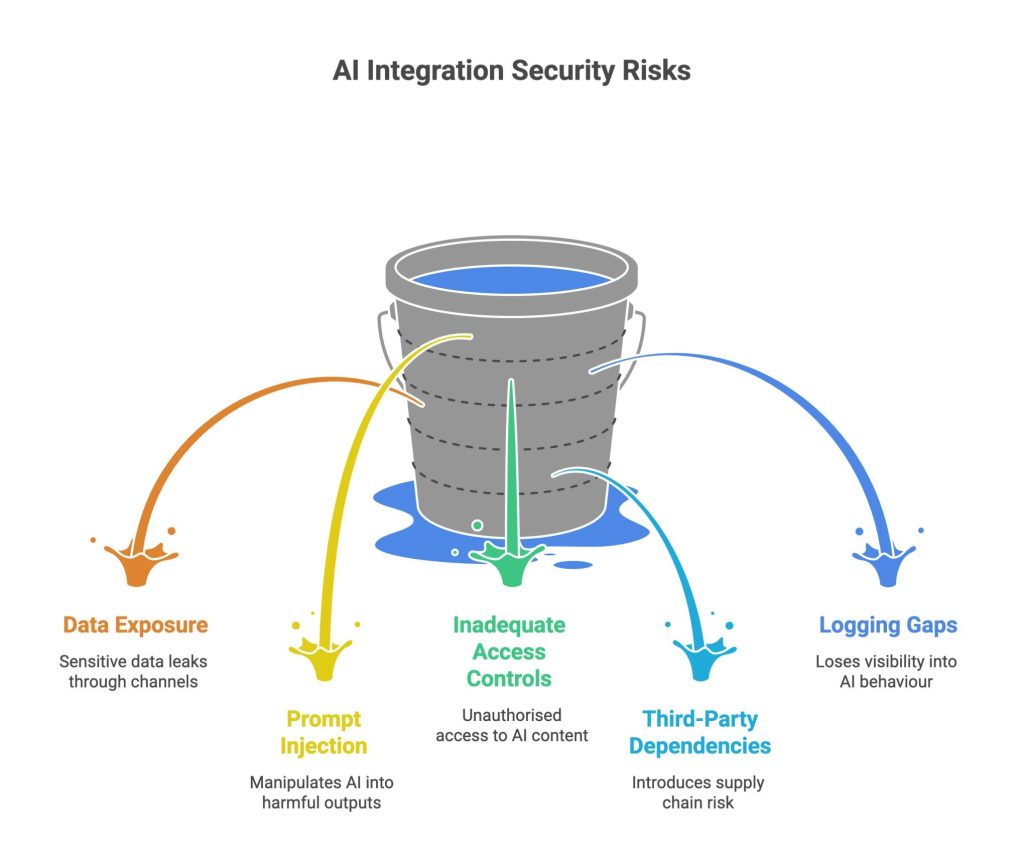
Security is the area where the gap between a responsible integration and a careless one is widest. For regulated organisations and platforms handling sensitive data, these risks are not theoretical.
- Data exposure through model inputs and outputs: When an AI feature processes user data, that data may be sent to external AI services, stored in logs, or surfaced in responses to other users. Without strict data handling controls, sensitive information can leak through channels the original platform was never designed to expose.
- Prompt injection and adversarial attacks: User-facing AI features that accept natural language input are vulnerable to prompt injection, where a user crafts input designed to manipulate the AI into revealing system instructions, bypassing restrictions, or producing harmful outputs. This is a well-documented and actively exploited attack vector that requires specific defences.
- Inadequate access controls around AI-generated content: If an AI feature generates reports, recommendations, or summaries, the access permissions governing that output must match the sensitivity of the underlying data. A poorly configured AI assistant that summarises confidential records for users who should not have access to them creates a data breach through the AI layer, even if the underlying data is properly secured.
- Third-party AI service dependencies: Many AI integrations rely on external services for inference, embedding, or model hosting. Each external dependency introduces supply chain risk: Service outages, pricing changes, data processing terms that may conflict with regulatory requirements, and model updates that alter behaviour without warning.
- Logging and auditability gaps: When AI influences or makes decisions within a product, those decisions need to be logged, traceable, and auditable. If the AI layer operates outside the platform’s existing audit framework, the organisation loses visibility into a critical part of the product’s behaviour, precisely where regulators and compliance teams will look hardest.
These risks are manageable. But they must be addressed in the design phase, not discovered in production.
A Practical Framework for Adding AI Features Safely
The safest and most effective way to add AI features to existing software is through a structured, phased approach that treats the AI layer as a distinct component with its own governance, testing, and monitoring requirements.
- Audit the existing architecture: Before any AI work begins, assess the current system’s architecture, data flows, infrastructure capacity, and security model. Identify the integration points where AI can connect without requiring wholesale changes to the platform. Understand the constraints, dependencies, and risks that will shape the implementation.
- Define where AI adds measurable value: Not every feature benefits from AI. Prioritise use cases where AI solves a real user problem, reduces meaningful operational cost, or creates a competitive advantage that justifies the integration complexity. Discard ideas where AI adds novelty without substance.
- Design the AI layer to be modular and isolatable: The AI components should be architecturally separate from the core platform, connected through well-defined interfaces. This allows the AI layer to be tested independently, updated without affecting the rest of the system, and rolled back quickly if issues arise. Tight coupling between AI features and core application logic is a common and costly mistake.
- Implement governance controls from the start: Access restrictions that define what data the AI layer can consume and what actions it can take. Input validation and output filtering to prevent prompt injection and data leakage. Comprehensive logging of all AI interactions, decisions, and data access. Human oversight mechanisms for high-stakes actions, ensuring the AI assists rather than acts unilaterally.
- Test in staging with realistic data and adversarial scenarios: AI features must be tested with production-representative data, not synthetic datasets that miss the edge cases real users will encounter. Include adversarial testing: Attempt prompt injection, test with unexpected inputs, and validate that access controls hold under pressure.
Deploy incrementally and monitor continuously. Roll AI features out to a subset of users first. Monitor performance, accuracy, latency impact, error rates, and user behaviour. Use this data to refine the feature before broader release. Post-launch monitoring is not optional; AI behaviour can drift as data patterns change, and ongoing oversight is essential.
Enhance Your Platform with AI That Works
Xanda helps businesses add AI features to existing software without compromising security, stability, or user trust. With over 27 years of experience delivering for government, regulated organisations, and ambitious SMEs, we integrate AI where it creates measurable value and build the governance controls to support it.
If you are exploring how AI can improve your existing product, book a free consultation to discuss your project.
FAQs
1. Can AI Features Be Added to Legacy Software?
Yes, in most cases. The approach depends on the existing architecture, data accessibility, and infrastructure capacity. AI features are typically integrated as modular components that connect to the existing system through APIs or data pipelines, rather than requiring a full rebuild. Legacy platforms with monolithic architectures may need some preparatory work to create clean integration points, but this is standard engineering practice, not a reason to delay.
2. How Do You Keep Existing Software Stable When Adding AI?
Stability is protected through architectural separation, phased delivery, and rigorous testing. The AI layer is designed as a distinct component with well-defined interfaces, so it can be tested, updated, and rolled back independently of the core platform. Incremental deployment to a subset of users before broader release ensures that any issues are identified before they affect the full user base. Continuous monitoring post-launch provides early warning of performance or reliability changes.
3. What Are the Security Risks of Integrating AI into Business Applications?
The primary risks include data exposure through model inputs and outputs, prompt injection attacks on user-facing AI features, inadequate access controls around AI-generated content, supply chain risk from third-party AI service dependencies, and logging gaps that reduce auditability. Each of these risks is well understood and manageable through proper architecture, governance controls, and security review during the design and implementation phases.
4. How Long Does It Take to Add AI Features to an Existing Product?
Timelines vary based on the complexity of the AI feature, the state of the existing architecture, and the data preparation required. A focused AI feature with a clean integration point can move from discovery to production deployment within weeks. More complex integrations involving multiple data sources, custom model work, or significant infrastructure changes may take several months. A phased approach delivers usable features early while allowing the scope to expand over time.
5. Should We Build Custom AI Features or Use Third-Party AI Services?
The answer depends on data sensitivity, regulatory requirements, and how central the feature is to your product. Build custom when proprietary data, strict security controls, or unique workflows are involved. Integrate third-party services when speed matters and the use case is well-served by general-purpose models, provided data governance allows it. A hybrid approach is often most practical: Third-party services for general capabilities, custom-built for anything touching sensitive data or core business logic.